Egos and Ideology
In 60 seconds
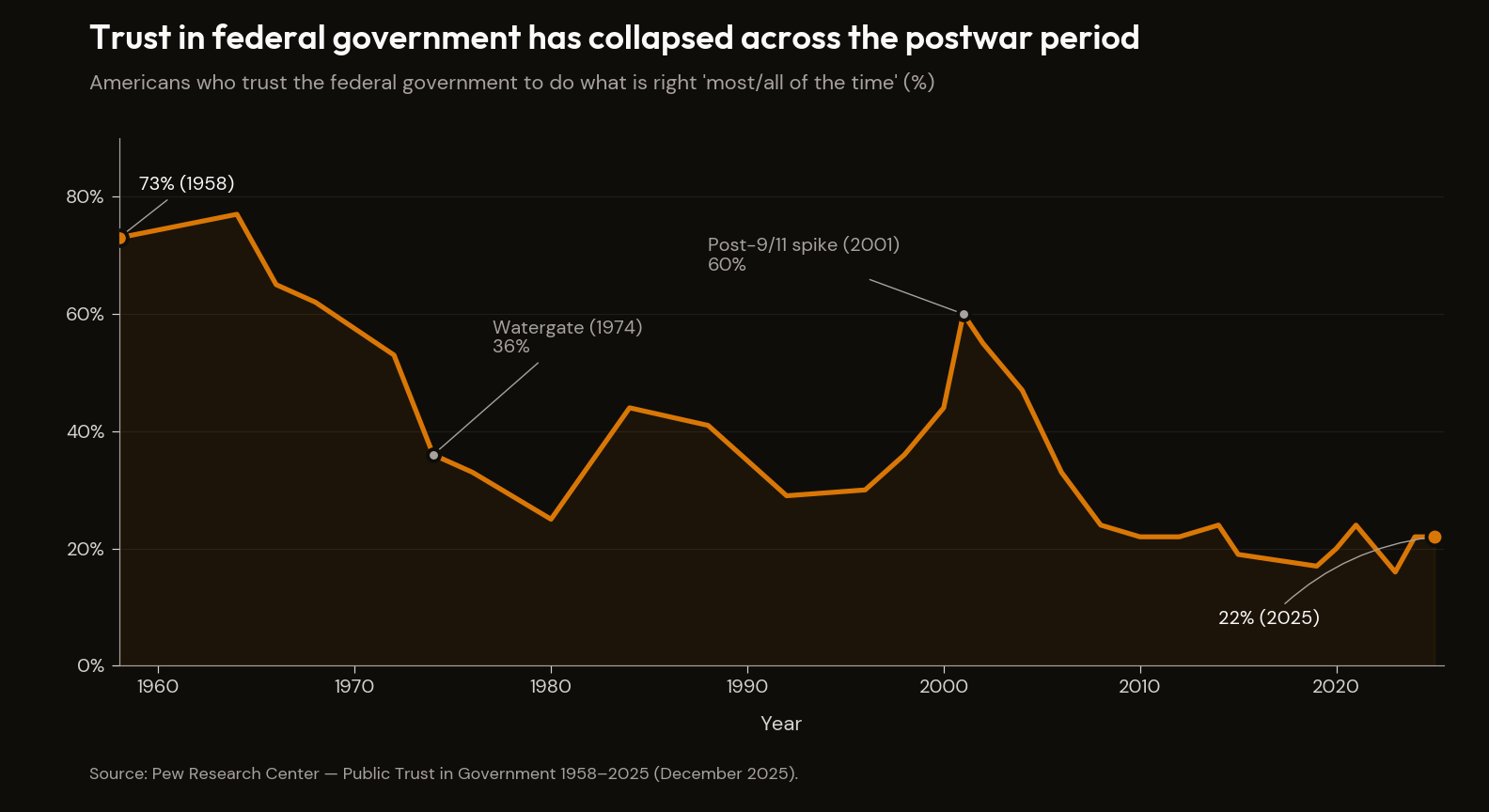
Democratic backsliding is no longer a tail risk — it is the modal pattern across roughly a quarter of the world's nations, running on a readable 18–36 month schedule. Trust in federal government at 17%; political-violence tolerance at 20–30%, depending on the poll's wording; the information environment now delivers persuasive falsehood at $20 a month. Political fragility and financial fragility are not separate windows; they are the same window.
The arithmetic this manuscript has documented ends on a configuration the historical record recognises. Ferguson's Law breached in FY2024. Turchin's Political Stress Index reaching 37 by 2012, a level last seen in the United States in the 1850s. G7 sovereign debt-to-GDP back at the only prior peacetime peak. The first synchronous developed-world working-age population peak in approximately six hundred years. The configuration was not unprecedented. It was the configuration that, in the historical record, precedes structural reorganisation.
What the diagnostic block did not specify is the political mechanism through which a configuration of that kind is processed. Turchin's Political Stress Index is itself a composite — elite overproduction, mass immiseration, fiscal exhaustion. The reading is the symptom; the symptom has to be transmitted through some institutional substrate before it produces an outcome. In the comparable historical episodes, the substrate was monarchical court, oligarchic senate, or single-party state. In the present episode, the substrate is the electoral democracy. The question Egos and Ideology takes up is what happens to the diagnostic block's arithmetic when it is processed through democratic institutions running under the political conditions of 2026.
The answer, drawn from the empirical record this essay will assemble, is acceleration. Not because particular elections produced particular leaders. Not because politics has become more corrupt than it used to be — it has not, on the long view, and the manuscript discipline does not permit the romanticism of an imagined cleaner past. The acceleration is structural. Three independent acceleration mechanisms, each with a traceable empirical date, are now operating simultaneously and in the same direction across the developed democracies: a measurable architectural change in the cost structure of in-group signalling and out-group hostility (Haidt's 2009 platform-architecture inflection); a pattern of democratic backsliding with a readable 18–36 month median timeline from populist authoritarian election to clear institutional capture (Levitsky and Ziblatt's case record); and the activation of a latent authoritarian disposition by the precise category of normative-order disruption that the diagnostic block's demographic and economic configuration generates (Stenner's authoritarian dynamic). These are not three manifestations of a single underlying cause. They are three independent mechanisms that have converged on the same window. The simultaneity is the load-bearing observation — and §VII engages the fourth and qualitatively different mechanism: the thermostatic-correction layer that democratic political systems exhibit when overreach generates its own pushback. The two-horizon discipline this essay sustains is that the acceleration mechanisms and the corrective mechanism are operating concurrently, and the watch-window question is which set bites first.
The argumentative spine, stated up front so the rest of the essay can be tested against it: the political amplifier is running on a measurable schedule; the schedule is readable; the activation mechanism is structural rather than pathological; and the financial fragility documented in Movements I–II and the political fragility documented here are not independent — each makes the other harder to fix. The essay does not predict American collapse. It documents what the historical pattern looks like, where the present configuration sits inside that pattern, and what the schedule the pattern runs on implies for the diagnostic block's watch window.
What this essay does not do should be named so the reader can hold the argument to it. It does not name specific contemporary political figures; the argument is regime-level, not personality-level, and the four warning signs in Levitsky and Ziblatt are diagnostic criteria rather than partisan commentary. It does not employ the conspiratorial framings — Great Replacement, civilisational characterisations of populations of nine or ten figures — that the manuscript's discipline rules out. The disciplined version of the argument is sharper than the politicised version, not merely more polite.
I. Why a Political Essay Belongs Inside a Financial Manuscript
The diagnostic block argues from arithmetic. This essay argues from political science. The reader's reasonable first question is why they belong in the same manuscript at all.
The answer is mechanism. Financial fragility and political fragility are not the same mechanism, but they are coupled, and the coupling runs both ways. The demographic arithmetic of The Demographic Crunch compresses wages for low-skilled native workers in non-tradeable services; the platform architecture this essay documents amplifies the political signal that compression generates; the backsliding schedule this essay documents compresses the time horizon over which complex long-duration investment is rational; and the immigration-restriction politics generated by the salience mechanism this essay documents tightens the very labour-supply constraint the demographic essay diagnosed. Each multiplier sits on the other. The diagnostic block describes a system breaking on its own arithmetic; whether the political response cushions or accelerates the breakage matters as much as the breakage itself, and that question has an empirical answer this essay is obligated to give before The Democratic Trap names the structural reason the response is what it is.
A second reason for the placement is harder. The diagnostic block depends, for its arguments, on institutional functioning that the political amplifier is in measurable decline. Treasury data, NERC and FERC reliability filings, BLS labour-market series, SEC-policed 10-Q segment data — the analytical machinery is built on the institutional infrastructure that produces, audits and disseminates it. That infrastructure is part of the apparatus the political amplifier is, on the V-Dem 2026 reading, dismantling. A diagnostic that depends on institutional integrity has to engage the political mechanism that puts the integrity in question.
II. The Architectural Cause
The mechanism for why now is architectural rather than cultural, and it has a precise date — the date is what makes it falsifiable.
In 2009, Twitter introduced the retweet button. Facebook introduced the Like button in the same year. Both features scaled to mass adoption between 2010 and 2012. The specific affordance is sharply describable: one-click amplification of content to a user's full network, with engagement metrics made publicly visible. The architectural change is not "social media exists." It is one specific change in two specific products that altered the cost structure of two specific social activities simultaneously. The cost of signalling in-group loyalty fell toward zero; any retweet of approved content is a public loyalty signal at no social or cognitive cost. The cost of out-group hostility fell toward zero; any repost of outrage content is a public attack at no social cost, and the algorithmic feed amplifies the engagement it generates.
Prior media regimes had in-group signalling and out-group hostility. They lacked the scale, the speed, and the measurable social reward attached to both. A letter to the editor is a high-cost signal. A retweet is near-zero cost and delivers a dopamine pulse from a public counter. The mechanism that is robust across studies — upstream of any individual-level radicalisation claim — is that one-click amplification at zero marginal cost selects for the subset of content that maximises engagement. Vosoughi, Roy and Aral's 2018 Science paper established what that subset looks like, on roughly 126,000 verified rumour cascades on Twitter from 2006 to 2017 with classifications confirmed by six independent fact-checking organisations.1 Their finding, in their verbatim language, is that "falsehood diffused significantly farther, faster, deeper, and more broadly than the truth in all categories of information, and the effects were more pronounced for false political news than for false news about terrorism, natural disasters, science, urban legends, or financial information." Six times faster. Ten times more reach. Ten layers deeper. The mechanism is not bot-driven; the same paper is explicit: "Contrary to conventional wisdom, robots accelerated the spread of true and false news at the same rate, implying that false news spreads more than the truth because humans, not robots, are more likely to spread it."1 The architecture rewards the content that drives the political mechanism.
The measurable outcome inflected three years after the architectural cause. Adolescent depression and anxiety inflected sharply between 2012 and 2013, increasing fifty to one hundred percent on key measures, with the largest movement among adolescent girls. The same window saw US political polarisation indices begin a measurable post-2012 acceleration. The pattern appeared on a similar timeline in Canada and the United Kingdom. The international character of the inflection is the falsifying check: a US-specific cause would not align Canadian and British timelines. They align.
The dates should be kept distinct. The architectural change is 2009. The measurable outcome inflects 2012–2013, as the features scaled to mass adoption. The lag is the time the affordance takes to reshape the network's selection function; the inflection is what the reshaped function produces.
The cross-essay link is exact, and is the platform-architecture side of the manuscript's fourth motif. The End of the Bull Run argued that the marginal price-setter in equity markets is no longer the informed value investor — it is an algorithm, executing a rule without reference to underlying valuation. The marginal narrative-setter in democratic discourse is no longer the informed citizen; it is an algorithm, executing engagement-maximisation without reference to the underlying truth of any signal. The Democratic Trap extends the motif to the synthetic-media supply side; Egos anchors the platform-architecture side.
III. The Backsliding Pattern
The backsliding pattern is the essay's concrete empirical anchor — the empirical scaffold The Democratic Trap can reference without re-quoting.
Gradual erosion — the wrong reference class is the coup
Democracies can vote in regimes that dismantle the liberal-procedural architecture of democracy without ceasing to be electoral. Mounk's The People vs. Democracy (2018) names the split: illiberal democracy (elections held, rights protections gutted) and undemocratic liberalism (rights protected, electoral responsiveness eliminated); only the first is active in the current wave. The argument across the book is that established democracies are now more vulnerable to gradual institutional erosion by elected leaders than to the older coup-and-junta model the post-war framework was designed to prevent. The threat is not Caesar at the gates. It is a sequence of individually defensible, legally procedural, slow decisions by leaders who took office through legitimate elections.
The warning signs and the timeline
Levitsky and Ziblatt's How Democracies Die (2018) drew four warning signs from the post-Cold War record — weak commitment to democratic rules of the game; denial of opponents' legitimacy; toleration of violence; readiness to curtail civil liberties.2 These are diagnostic criteria rather than partisan flags, designed to be applied symmetrically. The essay applies them as such.
The book's sharpest formulation, from the Introduction, anchors the structural claim. "Democracies may die at the hands not of generals but of elected leaders — presidents or prime ministers who subvert the very process that brought them to power. […] Like Chávez in Venezuela, elected leaders have subverted democratic institutions in Georgia, Hungary, Nicaragua, Peru, the Philippines, Poland, Russia, Sri Lanka, Turkey, and Ukraine."2 These countries do not share a culture, an institutional history, or an economic structure. They share the pattern. The pattern is what requires explanation; cultural or charismatic-leader accounts cannot explain the simultaneity.
Two unwritten norms hold the institutional architecture together where the formal rules cannot: mutual toleration, in which competing parties accept each other as legitimate rivals rather than existential enemies, and forbearance, in which leaders exercise restraint in wielding institutional power even where the formal rules would permit aggression. Levitsky and Ziblatt locate these as the substrate of US constitutional functioning since the late nineteenth century, and identify their erosion since the 1990s as the precondition for the present vulnerability. The substrate that made the architecture work has been eroding for thirty years, and the erosion has accelerated since 2016.
The case record, compressed
The case record is the load-bearing empirical evidence for the spine number — the median 18–36 month timeline from populist authoritarian election to clear institutional capture.
| Case | Window | Mechanic | Span |
|---|---|---|---|
| Hungary (Fidesz / Orbán) | 2010 onward | Constitutional supermajority, wholesale constitutional replacement, judicial retirement age lowered, media law consolidating state media, electoral system redrawn | 24 months to clear capture |
| Venezuela (Chávez) | 1998 onward | Constituent assembly to new Bolivarian constitution; decree-law power; judiciary packed; opposition media pressured under conditions of asymmetric party fragmentation | 36 months |
| Philippines (Duterte) | 2016 onward | Executive power and systematic non-enforcement; prosecutor's office captured; opposition arrested; extrajudicial drug-war killings normalised | 24 months |
| Poland (PiS) | 2015 onward | Constitutional Tribunal packed; Supreme Court overhauled; lower-court advancement politicised; state television converted to propaganda outlet; pace partly slowed by EU rule-of-law conditionality | 48 months |
Kim Lane Scheppele documented Hungary's speed in Journal of Democracy 23(3) in 2012: "In just two years, they [Fidesz] have fundamentally changed the constitutional order of Hungary... the new constitutional order permits the governing party to lodge its loyalists in crucial long-term positions with veto power over what future governments might do."3 The mechanism is wholesale constitutional replacement designed to make future reversals procedurally near-impossible. Javier Corrales, in Autocracy Rising (Yale UP, 2023), formalises the structural condition that made the Venezuelan pace possible: asymmetrical party-system fragmentation, where the ruling party is unified while opposition parties are divided and weak.4
Weimar 1933 is the outer bound. Hindenburg appointed Hitler on 30 January 1933; the Enabling Act passed 23 March 1933 with a 66 percent Reichstag supermajority under intimidation; by June 1933 the remaining parties were banned. Six months from appointment to one-party state — and the Enabling Act amended the Weimar constitution, not suspended it. Democracy was voted away under procedurally legitimate forms by leaders who had been elected. The Weimar case is the outer bound for how fast the timeline can run when the enabling conditions for forbearance and mutual toleration have already collapsed before the populist authoritarian takes office.
The cross-case timeline, compressed against the same calendar:
| Case | Year of contested election / appointment | Time to first major institutional rupture | Time to consolidated illiberal regime / democratic recovery |
|---|---|---|---|
| Weimar Germany | Jan 1933 (Hitler appointed) | March 1933 (Enabling Act) | 6 months to one-party state |
| Hungary | 2010 (Orbán re-elected) | 2012 (Fourth amendment to constitution) | ~24 months under EU membership; ongoing |
| Poland | 2015 (PiS elected) | 2016 (Constitutional Tribunal crisis) | ~48 months; reversible — Tusk 2023 |
| Turkey | 2013–14 (Erdoğan response to Gezi / corruption probes) | 2016 (post-coup purges) | ~30 months to consolidated regime |
| United States | (in progress, 2025–26) | (in progress) | (in window) |
The spine number — median time from populist authoritarian election to clear institutional capture: 18 to 36 months — synthesises across the cases, and the broader set Levitsky and Ziblatt list (Georgia, Nicaragua, Peru, Russia, Sri Lanka, Turkey, Ukraine) sits inside the same band. Backsliding is not a coup. It is a sequence of decisions on an empirically clocked timeline.
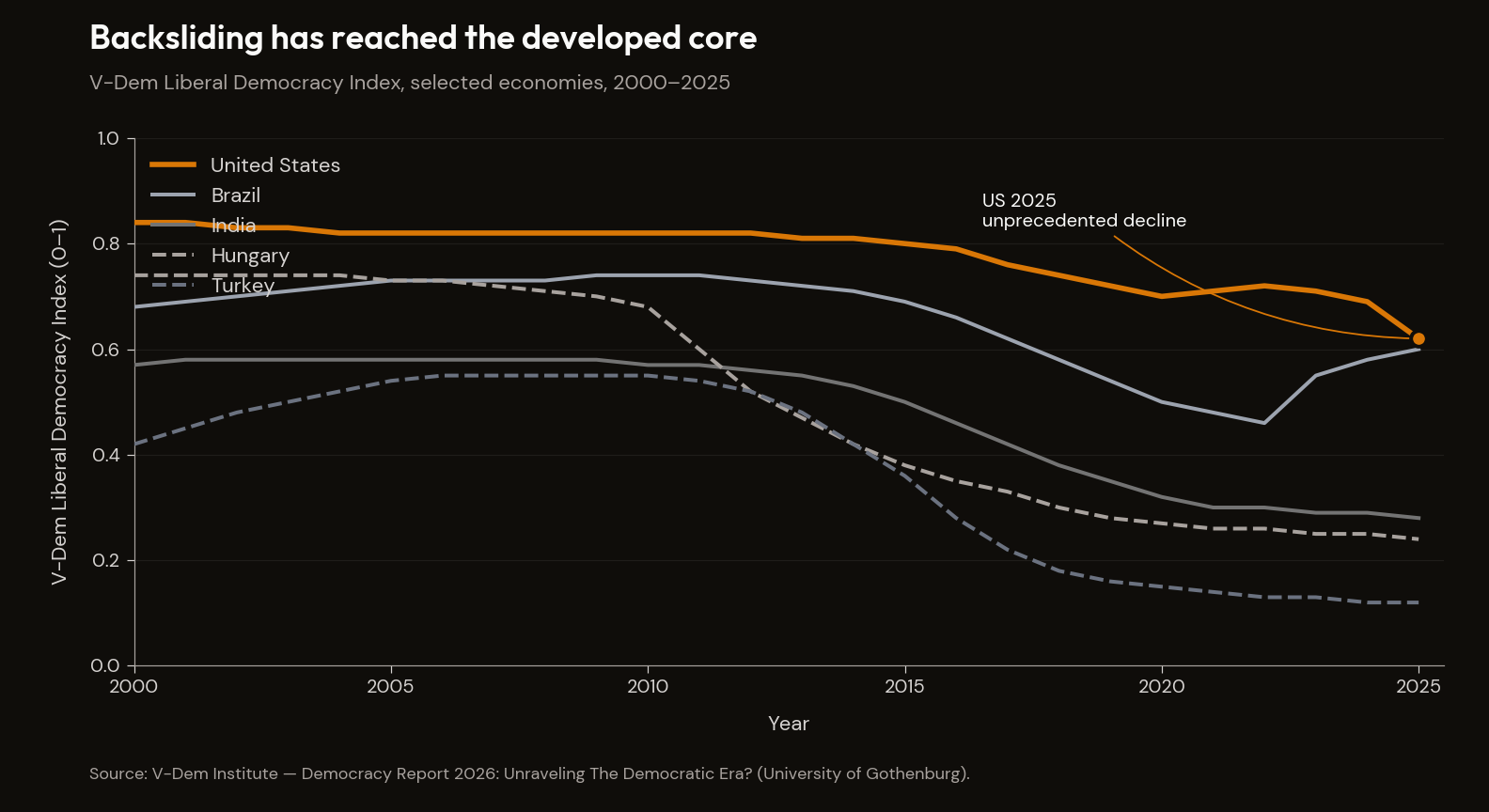
V-Dem's Democracy Report 2026 finds the United States sub-indices on judicial constraints on the executive, media freedom, and freedom of expression all moving adversely in 2025, with the country's world rank falling materially out of the top tier.5 Approximately a quarter of the world's nations are in active backsliding; six of the ten newly autocratising countries are in Europe and North America, including the United Kingdom, Italy, and the United States; Freedom House's parallel report logs twenty consecutive years of global freedom decline.6 The simultaneity is the empirical fingerprint of a structural mechanism.
IV. Why Now, Across So Many Democracies Simultaneously
The simultaneity across democracies is the unexplained piece. None of the previous sections explains why the same window appears in countries with different leaders, different institutional histories, and different economic structures.
The explanation is a mechanism rather than a personality: a latent authoritarian disposition, present at meaningful prevalence across the developed democracies, activated by perceived threats to in-group cohesion rather than by stable personality. Stenner's The Authoritarian Dynamic (2005) names it.7 When normative threat is low, the latent disposition expresses moderate or even liberal attitudes; when it rises (rapid value change, perceived diversity disruption, loss of shared cultural referents), the disposition activates sharply. The mechanism is a threshold, not a fixed trait. Authoritarians are not inherently aggressive; they are predisposed to defer to authority and accept hierarchy, but respond defensively when they perceive the consensual normative order is in danger of being subverted.
The latent disposition is roughly comparable in prevalence across the developed democracies. What has changed in the same window is the level of perceived normative threat. The diagnostic block has been documenting precisely the configuration that raises it: demographic change altering visible community composition faster than cultural assimilation can operate; economic compression and wage stagnation creating material-status anxiety; a working-age population peak that closes the post-1990 labour-supply tailwind; and the platform-architecture amplification of Section II raising perceived threat even where material reality is less severe than perception. The structural explanation is in the inputs, not in the personalities. The activated disposition is an over-response to a real input rather than a hallucination of a fabricated one; the demographic change is real, the wage compression is real, the economic-cohesion threat is real. The essay neither endorses the policy conclusions authoritarian populists reach nor dismisses the underlying perceptions as irrational.
The cross-essay back-reference is to The Demographic Crunch and The Math Doesn't Work. Political backlash against immigration is downstream of the demographic mechanism. The demographic essay documents the fuel; this essay documents the ignition. Stenner's mechanism is what produces the political constituency for short-horizon policy responses to long-horizon arithmetic — the can-kicking equilibrium that is the central feature of contemporary democratic governance.
There is a substrate between input and disposition that matters for durability. Mullainathan and Shafir's Scarcity established that financial stress reduces effective cognitive bandwidth — the directional finding, even where specific effect-size magnitudes have been contested in replication.8 Roughly forty to fifty percent of American households report less than one month's liquid savings to absorb a financial shock; the scarcity condition is mass-scale.9 The Political Floor (erosion of mutual toleration and forbearance) and the Dispositional Floor (latent authoritarian activation under normative threat) both rest on a prior Material Floor: the cognitive-bandwidth condition. Fix the institutional architecture without improving the material substrate, and the fix is temporary. When economic pressure returns across the 2026–2027 window, the bandwidth contraction returns with it.
Inglehart and Welzel's World Values Survey, Wave 7 (2017–2022, 66 countries), provides the methodological discipline that prevents the section sliding into civilisational claims.10 Intra-cultural variance is large; the relevant value-gap is between metropolitan and non-metropolitan populations within each country, and this within-country gap has widened across the developed democracies over three decades. The framing is empirically grounded; the conspiratorial alternative is a feeling.
V. The Immigration Question, Done Honestly
This is the manuscript's most politically sensitive section. The version that survives engagement is the disciplined one.
What the empirics support
Immigration policy in the Western democracies between 1990 and 2020 reflected both demographic necessity and capital interests. Policy elites and business interests converged on permissive immigration as a demographic-and-labour necessity — interest convergence under demographic constraint, with diffuse costs to less-educated native workers in specific occupations and concentrated benefits to employers, professionals and the broader consumer surplus.
Native low-educated workers in specific occupations and regions did face competitive pressure. The Borjas–Card debate over the magnitude is genuinely contested. Card's 1990 Mariel boatlift study found no detectable wage decline for less-skilled workers in Miami despite a seven-percent labour-supply shock.11 Borjas's 2017 reanalysis, restricting the sample to high-school dropouts, found wage declines of 10 to 30 percent for that subgroup.12 Peri and Ottaviano argued capital adjustment over time eliminates the medium-run wage effect through complementarity.13 Caiumi and Peri's 2024 NBER synthesis finds near-zero aggregate national wage effects for post-2000 US immigration on the grounds that recent migrant flows have been more educated.14 The wage-elasticity estimates span roughly an order of magnitude; a responsible reading holds the contestation rather than collapses it.
The section's central argument does not depend on resolving the debate. The political mechanism runs through salience. Eric Kaufmann (Whiteshift, Abrams, 2018)15 and James Dennison (IJPOR 32(3), 2020)16 have established the mechanism separately and consistently. Across 28 European democracies, immigration salience — how much voters perceive immigration to be an important issue — is the strongest single predictor of populist-right vote share, stronger than unemployment, crime, terrorism, or absolute economic conditions. Even in a world where Card is completely correct and immigration produces zero aggregate wage effect, immigration salience would still predict populist voting because the mechanism runs through perception. The political signal is not waiting for the wage-economics literature to settle.
The motif is addition, not substitution. Immigration salience does not replace existing political alignments; it is added to them. Voters who carry pre-existing partisan commitments do not switch parties on immigration salience; they sort more sharply within their existing alignments. Salience is a polarisation amplifier rather than a realigner.
What the empirics do not support
The Great Replacement framing — an intentional, coordinated elite conspiracy to replace native populations through immigration policy — is not supported by the documentary record. Elite consensus in favour of permissive immigration emerged from the convergence of demographic necessity and capital interest, well-documented as such. There was no coordinated design to replace populations; there was a sequence of policy decisions made under interest pressure with diffuse distributional costs. Conflating distributional consequence with intentional design is the move the manuscript discipline rules out — not because the framing is impolite but because it is wrong on the documentary record. The empirically grounded version is sharper than the conspiratorial one.
David Goodhart's The Road to Somewhere (Hurst, 2017) supplies the cultural-geography framing the conspiratorial framings cannot.17 Somewheres are place-bound, geographically rooted populations whose identity is anchored in particular communities; Anywheres are cosmopolitan, portable, whose identity is anchored in professional networks. The two groups experience immigration differently: Anywheres interact with it as an economic and cultural positive, with the complementarity gains accruing to them; Somewheres experience the competitive pressure and the cultural change without the complementarity gains, in geographies the Anywheres rarely visit. This is not a moral hierarchy. It is a map of how the same policy generates different distributional experiences across class and geography. The structural conflict is between geographically and economically different segments of the same democratic electorate, processed through immigration as a symbol that aggregates the underlying distributional conflict into a single political issue.
The section's load-bearing claim, stated with the discipline the manuscript requires: the political response to demographic change is driven by the salience of immigration in voters' cognitive priority hierarchy; the mechanism is perceptual rather than material; the perception is generated by real demographic change with real distributional consequences for specific cohorts in specific geographies; and the political alignment that results is most accurately read as a Somewheres–Anywheres fault line within each democracy. The disciplined version is, by some distance, the politically less inflammatory one. Sound empirics produce sound politics. The conspiratorial framings collapse on contact with the data; the disciplined framing does not.
VI. The Cross-Border Network
Backsliding regimes are now networked. Orbán's Hungary models constitutional-capture techniques for aspiring autocrats elsewhere; Russia's interference infrastructure transfers methods across friendly regimes; Chinese capital generates economic dependencies that constrain the foreign-policy independence of recipient states. Anne Applebaum's Autocracy, Inc. (Doubleday, 2024) documents the transnational dimension across case studies. The transnational network explains why the techniques diffuse faster once developed; it does not explain why the political conditions for them exist in the first place. The conditions are produced inside each polity by the interaction of the diagnostic block's configuration with the mechanisms this essay has documented. The essay's central claim depends on the domestic mechanisms operating at the intensities V-Dem and Freedom House record.
VII. The Thermostatic Correction
The three acceleration mechanisms above — Stenner's authoritarian-disposition activation, Haidt's platform-architecture amplification, and Levitsky-Ziblatt's elected-leader erosion pattern (whose empirical case timeline §III walks through in detail) — describe what overreach looks like and what democratic decay produces over an 18-to-36 month schedule. They do not describe what happens when the overreach generates its own correction. That is the fourth mechanism, qualitatively different from the three above, and the one this section engages.
The Pendulum framework — Schlesinger's Cycles of American History (1986),18 updated empirically through Levitsky and Way's work on competitive authoritarianism — argues that democratic political systems exhibit oscillatory behaviour as a structural feature, not as a contingent recovery story. When one side overreaches, the median voter shifts back; opposition coalitions form on the visible cost of the overreach; institutional actors (courts, civil service, central banks, state attorneys general, municipal authorities) develop friction against the executive direction; and the political economy of the next election cycle is shaped by the dissatisfaction the overreach produced.
The empirical record across the backsliding cases is consistent with the framework. Poland's PiS government, which Levitsky and Ziblatt treat as a paradigm backsliding case, lost the 2023 election to a Donald Tusk-led coalition that ran explicitly on institutional restoration. The post-2023 Polish reconstruction is incomplete and contested, but it is real. The South Korean impeachment of Park Geun-hye in 2017, the partial UK reversal of the Truss 2022 mini-budget within 44 days, the Slovakian opposition vote against Fico's NATO-pivot in 2024, the rolling judicial and electoral pushback against Hungarian and Turkish overreach — none of these are guarantees, but they are evidence that the thermostatic mechanism is not extinct.
The Pendulum framework does not refute the backsliding thesis. It complicates it. The right reading of the empirical record is that some backsliding episodes consolidate into one-party rule and some reverse — and the variables that determine which are partly contingent (specific opposition leadership, specific institutional friction, external constraints like EU membership or trade-bloc conditionality) and partly structural (depth of prior democratic culture, electoral rules, geographic distribution of voter preferences).
For the United States in 2026, the framework's relevance is direct. The watch-window question is not whether backsliding-pattern dynamics are present — they are, by V-Dem coding — but whether the thermostatic mechanism produces sufficient correction inside the window the diagnostic block describes. That is a different question, and it is not settled by the four-mechanism framework above. It is settled by whether the median voter's reaction crystallises against the cost of overreach on a timeline that bites inside the watch window — which the demand-side trap in The Democratic Trap (the median voter's inability to absorb short-term pain) argues it may not.
The honest reading is that backsliding mechanisms and thermostatic-correction mechanisms operate concurrently. The manuscript's bear case is that the financial fragility documented in Essays 1–8 amplifies the cost of overreach and accelerates thermostatic-correction onset. The manuscript's bull case is that the same financial fragility raises the political-economic stakes high enough to suppress thermostatic correction within the watch window. Both are plausible. The two-horizon discipline holds: the political mechanism, like the financial one, has fragility and correction running through it.
VIII. Where This Lands for Markets
The political amplifier translates into specific, measurable costs that compound the financial mechanisms documented in Movements I and II. Three are load-bearing.
The first is regulatory and judicial capture. The 18–36 month timeline compresses the time horizon over which complex, long-duration investment is rational — not because property rights are eliminated but because the independence of the courts and regulatory agencies that enforce them is compromised. Hungary post-2012 is the canonical case: Fidesz directed regulatory and procurement decisions toward politically aligned businesses after constitutional-court capture, with FDI patterns shifting measurably toward firms with credible political alignment. The diagnostic block's arithmetic assumes property-rights enforcement at developed-democracy 1995 standards; the 2026 V-Dem reading already prices in some erosion, and the further erosion Section III makes plausible compounds the equity-market risk premium documented in The End of the Bull Run.
The second is the labour-supply tightening that the political response to immigration generates. The Demographic Crunch established that the demographic mechanism requires immigration to offset ageing-population labour deficits; without it, the labour-supply tailwind reverses into a structural wage-inflation tailwind for non-tradeable services that keeps rates higher for longer. Politically driven immigration restriction accelerates the tightening rather than offsetting it. The political amplifier tightens the very labour-supply constraint the demographic essay diagnosed.
The third is the polarisation-driven shortening of the corporate strategic investment horizon. US firms have shortened capex planning horizons since 2015, on Federal Reserve Bank of St. Louis surveys and Business Roundtable data, with the shortening accelerating since 2020. When the regulatory, trade, and tax environment can swing 180 degrees between administrations with no cross-party floor, long-duration capital investment carries regime-change risk that did not exist under the prior consensus regime. The cost is borne disproportionately by long-duration capex projects with eight-to-twelve-year payback periods — including the AI hyperscaler infrastructure build of The AI Reckoning and The Energy Bottleneck. The political-amplifier path is incompatible with the long-duration-capex path the AI bull case requires.
The financial-fragility window and the political-fragility window are the same window. Each is operating on the other.
IX. Honest Counter-Arguments
Four counter-arguments deserve serious engagement rather than dismissal. The discipline of this section is to engage them at the strongest version available, concede where they have force, and then show what they do not change.
"Polarisation is symmetric"
Pew Research's polarisation tracking shows party unfavourability ratings have risen symmetrically across both major US parties since the 1990s, with large majorities of both Democrats and Republicans now viewing the other party unfavourably.19 The mass-level data is symmetric, and the symmetric reading is honest.
Symmetry at the mass level does not imply symmetry at the elite or institutional level. Levitsky and Ziblatt's Tyranny of the Minority (Crown, 2023) documents institutional asymmetry: one party has been more willing than the other to exploit constitutional hardpoints — gerrymandering, electoral certification, court-packing through vacancy strategies.20 V-Dem explicitly captures institutional erosion rather than attitudes.5 Stenner's framework applies symmetrically — both left and right can in principle activate authoritarian dynamics under normative threat. The institutional backsliding documented in this essay's spine numbers is, at the present moment, a one-directional empirical observation, not a partisan claim about who is morally worse.
"Institutions will hold — Poland 2023 proves it"
This is the most sophisticated counter. The reversibility claim is that Poland's 2023 democratic reversal demonstrates backsliding is not a one-way ratchet; the US-specific resilience claim is that constitutional redundancies (federalism, bicameralism, life-tenured judiciary) protect against Hungary-style architecture. Both are real and the essay concedes both. The counter to the counter is that Poland's reversal required eight years, a unified opposition coalition across deep ideological divides, and an external EU rule-of-law conditionality mechanism that applies only to EU member states. The timeline of backsliding (18–36 months) is shorter than the timeline of reversal (Poland: eight years), and even after electoral reversal Poland's courts remain compromised. In the manuscript's 2026–2027 watch window, the reversal timeline and the breakage timeline are not on the same clock.
The US-specific resilience claim is stronger but not decisive. The Levitsky–Ziblatt 18–36 month timeline is built on cases with initially stronger-looking institutions than they turned out to be — Hungary's Constitutional Court had real independence before 2010; Turkey's courts had real independence before 2013. Institutional strength is not always visible until tested. The historical instances where institutions held were in countries where the mutual toleration and forbearance norms were intact at the time of the test; their erosion in the United States since the 1990s is the precondition Levitsky and Ziblatt locate as the relevant vulnerability.
"Haidt overstates social media's effects"
Large-dataset replications find smaller effect sizes than Haidt's primary analysis on adolescent wellbeing — Przybylski and Orben in particular have anchored the lower-magnitude finding. The effect-size debate is real and the essay concedes it. The section's argument is held at the architectural-mechanism level, not the individual-wellbeing level. The political-amplification claim rests on the Vosoughi 2018 finding (six times faster, ten times more reach, on 126,000 verified rumour cascades), not the adolescent-wellbeing inflection. The discipline is to concede the contested magnitude where the contestation is empirically strong, and to hold the architectural mechanism where it is not.
The voters are biased counter-argument — Bryan Caplan's The Myth of the Rational Voter (Princeton, 2007) — is engaged at length in The Democratic Trap, which leans on Achen and Bartels's empirical voter framework rather than Caplan's; this essay flags the counter and defers.
X. The Schedule is Readable
The diagnostic arithmetic and the political-amplifier mechanism are coupled, and the coupling runs in one direction: financial fragility and political fragility compound each other inside the same 2026–2027 watch window. V-Dem's 2026 reading puts the United States sub-indices on judicial constraint, media freedom, and freedom of expression all moving adversely in 2025. Roughly a quarter of the world's nations are in active backsliding on the same data; six of ten newly autocratising countries are in the developed core. The Levitsky–Ziblatt 18–36 month median timeline is the empirical schedule the present configuration runs on. Stenner's authoritarian dynamic explains why the activation is appearing simultaneously across so many democracies rather than being the product of any single charismatic leader. The Kaufmann–Dennison salience finding explains the specific political signal the activation produces. Haidt's 2009 architectural inflection explains why the signal travels at the speed and intensity it does. The political mechanism is not a discount applied at the end of the diagnostic arithmetic; it is a multiplier applied through the same channels.
This essay does not predict American collapse. The historical pattern produces a constrained set of resolutions, and the path through that set is decided by decisions made under the configuration rather than by the configuration itself. The configuration is the input. The decisions are the path.
The political amplifier is running. The schedule is readable. What this essay cannot fully answer is why the system that can read the schedule cannot act on it before the schedule runs — that question belongs to The Democratic Trap.
I have dated this essay honestly. I will revise it.
Footnotes
-
Soroush Vosoughi, Deb Roy, Sinan Aral, "The spread of true and false news online," Science 359, no. 6380 (2018): 1146–1151. Roughly 126,000 verified rumour cascades on Twitter 2006–2017; six independent fact-checking organisations confirming classifications. Six-times-faster finding for false political news; bot-versus-human decomposition in the same paper. ↩ ↩2
-
Steven Levitsky and Daniel Ziblatt, How Democracies Die (Crown, 2018). Introduction — "elected leaders" formulation; the two halves of the cited passage are non-contiguous in the original (ellipsis marks the elision); four-warning-signs framework; mutual-toleration and forbearance as the unwritten substrate. Authors' précis in The Guardian (21 January 2018). ↩ ↩2
-
Miklós Bánkuti, Gábor Halmai, and Kim Lane Scheppele, "Hungary's Illiberal Turn: Disabling the Constitution," Journal of Democracy 23, no. 3 (2012): 138–146. "In just two years..." quotation; constitutional-replacement mechanic distinguished from targeted amendment. ↩
-
Javier Corrales, Autocracy Rising: How Venezuela Transitioned to Authoritarianism (Brookings Institution Press / Yale University Press, 2023) — Chapter 12 (Venezuela's Autocratization 1999–2021). Asymmetric party-system fragmentation as structural enabler; Chávez decree-law power. ↩
-
V-Dem Institute, Democracy Report 2026: Unraveling The Democratic Era? — press release on US decline. University of Gothenburg. United States sub-indices on judicial constraints on the executive, media freedom, and freedom of expression all moved adversely in 2025; six of ten newly autocratising countries in Europe / North America; approximately 25% of nations in active backsliding. ↩ ↩2
-
Freedom House, Freedom in the World 2026: The Growing Shadow of Autocracy. Twenty consecutive years of global freedom decline; backsliding affecting more than 40% of the world's population in 2025. ↩
-
Karen Stenner, The Authoritarian Dynamic (Cambridge University Press, 2005). Latent authoritarian disposition conditional on perceived normative threat; threshold mechanism rather than fixed trait. ↩
-
Sendhil Mullainathan and Eldar Shafir, Scarcity: Why Having Too Little Means So Much (Times Books / Henry Holt, 2013). Publisher landing (Macmillan/Picador). Indian sugarcane farmer pre-/post-harvest cognition experiments and US supermarket low-income shopper experiments. Specific effect-size magnitudes have been contested in subsequent replications; the directional finding on cognitive bandwidth under financial stress is the load-bearing claim. ↩
-
Federal Reserve, Report on the Economic Well-Being of U.S. Households (SHED) 2024. Approximately 40–50% of American households report less than one month of liquid savings to cover a financial shock; FRED PSAVERT series consistently below 5% since 2022. ↩
-
Inglehart–Welzel World Values Survey, Wave 7 (2017–2022) Documentation. ↩
-
David Card, "The Impact of the Mariel Boatlift on the Miami Labor Market," NBER Working Paper 3069 (1990). Published as Card, ILR Review 43, no. 2 (1990): 245–257. Seven-percent labour-supply shock; no detectable wage decline for less-skilled Miami workers. ↩
-
George J. Borjas, "The Wage Impact of the Marielitos: A Reappraisal," ILR Review 70, no. 4 (2017): 1077–1110. High-school-dropout sample restriction; 10–30% wage-decline estimate for that subgroup. ↩
-
Gianmarco I. P. Ottaviano and Giovanni Peri, "Rethinking the Effects of Immigration on Wages," Journal of the European Economic Association 10, no. 1 (2012): 152–197. Capital adjustment and complementarity argument; medium-run wage effect attenuated. ↩
-
Alessandro Caiumi and Giovanni Peri, "Immigration's Effect on US Wages and Employment Redux," NBER Working Paper 32389 (2024). Near-zero aggregate national wage effects for post-2000 US immigration on the grounds that recent migrant flows have been more educated. ↩
-
Eric Kaufmann, Whiteshift: Populism, Immigration and the Future of White Majorities (Abrams Press, 2018). Immigration salience as primary driver of right-populist support, robust to economic-condition controls. ↩
-
James Dennison, "How Issue Salience Explains the Rise of the Populist Right in Western Europe," International Journal of Public Opinion Research 32, no. 3 (2020): 397–419. 28 European democracies; immigration salience strongest single predictor of populist-right vote share. ↩
-
David Goodhart, The Road to Somewhere: The Populist Revolt and the Future of Politics (C. Hurst & Co., 2017). Somewheres-vs-Anywheres cultural geography; class-and-geography map of differential immigration experience. ↩
-
Arthur M. Schlesinger Jr., The Cycles of American History (Houghton Mifflin, 1986). The thermostatic-correction mechanism is updated empirically in Steven Levitsky and Lucan A. Way, Competitive Authoritarianism: Hybrid Regimes After the Cold War (Cambridge University Press, 2010), and in the comparative-democratisation literature on partial backsliding reversals (Poland 2023, Brazil 2022, South Korea 2017). ↩
-
Steven Levitsky and Daniel Ziblatt, Tyranny of the Minority: Why American Democracy Reached the Breaking Point (Crown, 2023). Institutional asymmetry argument; constitutional hardpoints and counter-majoritarian mechanics. Authors' précis at Harvard Gazette. ↩