Reading the Clocks
In 60 seconds
Five composite indicators operationalise the regime claim across the prior essays. As first published in May 2026, the dashboard said three sat at or above their thresholds. That overstated it. On the thresholds this essay itself defines, none did then, and none does as of September 2026: the AI capex/sales ratio is one leg short, and the Howell liquidity index has met its own falsification condition. The dashboard is the manuscript's commitment to falsifiability: when the indicators move, the bear case updates.
In the autumn of 2007, the clocks were ticking. Not one clock — the yield curve, or the TED spread, or the co-movement signal Bar-Yam's group at the New England Complex Systems Institute had been tracking for four years.1 All of them, simultaneously, pointed in the same direction. The US Treasury yield curve had inverted in mid-2006 and stayed inverted. The TED spread had begun to widen in August 2007 to levels not seen since the 1987 crash. The cross-equity correlation Bar-Yam's group was measuring had been rising continuously since 2004 — a structural signal that the equity market was becoming progressively more internally correlated, less genuinely diversified, more dependent on a single shared factor underneath the surface. Nobody needed a crystal ball. They needed a dashboard.
The lesson from 2007 is not that multi-signal convergence predicts crisis dates. The lesson is that when previously independent signals start reading together, the independence was always cosmetic — the shared structural condition is revealing itself through multiple diagnostic channels. The yield curve was reading the credit market. The TED spread was reading the interbank market. The NECSI co-movement signal was reading the equity market. Three independent diagnostics, three different data sets, three different methodologies, one composite reading of the same configuration through different lenses.
The 2026 configuration shows the same composite pattern. The diagnostic block of this manuscript identified the structural conditions across the preceding essays. The prior essay named the meta-clock and its four sub-readings; this essay does not revisit that diagnosis. It constructs the operational apparatus for reading those clocks in real time: five indicators, drawn from primary institutional sources, each paired with an explicit threshold condition and a falsification condition. The clocks are running. The question is how to read them honestly.
I. Why a Dashboard, Not a Forecast
The distinction between a dashboard and a forecast is not aesthetic. It is the difference between epistemically honest and epistemically dishonest engagement with an uncertain future. A forecast names a date and an outcome. A dashboard names the conditions that would confirm or disconfirm a regime claim, and it names them in advance.
The distinction matters because it sits inside a methodological category that has been empirically tested. Philip Tetlock's Good Judgment Project — the multi-year research programme that began in the late 2000s and produced its operating treatment in Superforecasting (Crown Publishers, 2015) — established that calibrated probability is a learnable skill with measurable accuracy.2 The accuracy is not universal. It is conditional. Calibrated reading works when the reference class is well-populated, the components are arithmetically constrained, and the forecaster updates on falsification rather than on reinterpretation. Where those conditions hold, the calibration discipline produces measurable improvement over baseline expert judgment. Where they do not — where the underlying distribution is fat-tailed and historically sparse, where the components are themselves the products of regime change rather than constraints within a stable regime — the calibration apparatus systematically misreads its own confidence intervals.
This essay is in the conditional domain Tetlock's research validates. Sovereign debt maturity calendars are fixed at the date of issuance. Demographic projections are actuarial across a multi-decade horizon. Liquidity cycle durations are structurally tied to debt-maturity profiles. Every threshold in the dashboard below is derivable from primary arithmetic against a published institutional series. The reference class for each indicator is well-populated; the components are arithmetically constrained; the falsification conditions are stated before the signals arrive.
Severity is a different question entirely. Taleb's framework establishes that fat-tailed distributions cannot be calibrated from sparse historical samples; the how bad question about a major sovereign-financial stress episode sits in that domain, not the when are the conditions present question.3 This essay reads the timing of convergence; it does not read the severity of what crystallises when the clocks tick together — that remains, as Taleb's framework establishes, genuinely unknowable in advance. The Tetlock domain and the Taleb domain are not in tension. They operate at different levels. The manuscript carries both because the claims are layered: the fragility apparatus explains what is at stake; the convergence apparatus explains when the at-stake is likely to manifest.
Falsification discipline is named upfront, not saved for the end. A dashboard without falsification conditions is a confirmation-bias machine wearing analytical clothing. Every indicator in the dashboard below carries an explicit falsification condition — the reading that would falsify that specific indicator's analytical claim, not merely defer it. The method is Bayesian in structure rather than in surface vocabulary. Prior beliefs — the regime claim from the diagnostic block — update on new signal; the update rules are stated here, not invented at the point of signal arrival.
The discipline that holds the whole apparatus together is simple: the analyst who moves the goalposts when a falsification condition approaches has exited the calibrated-probability domain and entered something else. State the conditions in advance. Watch the indicators against them. Update when the conditions are genuinely met — not when the signal is convenient.
The dragonfly-eye aggregation method — independent frameworks arriving at convergent conclusions through different analytical starting points — governs the dashboard that follows. The apparent independence of the five indicators is partial: the meta-clock (Howell) was built in as the master variable; the other four indicators are coupled to it through the dollar-liquidity vector. The convergence reading is what emerges when the master clock's transition is confirmed by the sub-readings on their own data. September 2026. The master clock has not made that transition. On the level Howell publishes it met its own falsification condition instead, and two of the three convergence cases in §III cannot fire until it descends. Until then the regime signal has to come from the other four indicators on their own data, which is a harder test for the regime claim, not an easier one.
II. The Indicator Dashboard
The dashboard is the chapter's central artefact. The five indicators, paired one-to-one with threshold and falsification conditions, are first set out as a single table; the prose that follows is commentary on the rows.
| # | Indicator | Threshold for "at-or-above" | Falsification condition | Reading (September 2026) | Source-essay |
|---|---|---|---|---|---|
| 1 | Howell Global Liquidity Index (level, US$ trillions) | Descent from the early-2026 peak, sustained across three consecutive monthly readings | Re-acceleration above the early-2026 peak, sustained across three months | Above the February record of US$189.2tr in every public reading since late April; above US$196tr on 22 September. Below; falsification condition met | Essay 12 |
| 2 | Hyperscaler capex / sales ratio (Microsoft, Alphabet, Amazon, Meta; cash capex) | Ratio above twice its 10-year norm (so above 25%) for two consecutive quarters, AND aggregate capex at or above $750B annualised | AI-attributable revenue above $100B a year at a major hyperscaler, as the company states it, on a sustained growth path | Ratio 30.1% (Q1), 35.0% (Q2); capex $660B annualised (Q2). Below: one leg of two met | Essay 4 |
| 3 | Mag 7 forward EPS revisions × multiple behaviour (conjunction) | Conjunction (BOTH legs adverse): EPS revisions -10% YoY AND multiple compression >25% (S&P 500 forward P/E below ~15.3, from 20.4 on 30 June 2026), for two consecutive quarters | Conjunction (BOTH legs benign): EPS revisions hold/accelerate AND multiple expands, for two consecutive quarters | S&P 500 Q2 earnings +52% y/y; forward P/E 19.6, down from 20.4 at end-June. Below; neither conjunction met | Essay 2 |
| 4 | OASI / HI legislative action | The 2026 mid-terms and the 2027 session pass without major reform tabled and advanced through committee | Major reform enacted, phased in from 2026 or 2027, that pushes depletion outside the 2026–2030 stress window | OASI depletion in 2032 on both the Trustees' and CBO's current-law projections; nothing enacted. Not yet testable | Essay 1 |
| 5 | Credit-fragility composite | Any two of: bad-PIK shadow default rate above 7%; office CMBS delinquency above 15%; redemption requests above 25% of shares at a majority of five named non-traded BDCs, for a quarter | All three revert: shadow default below 3%, office CMBS below 8%, gate utilisation below 5% | Shadow default 6.2% (Q2); office CMBS 12.00% (August); every large non-traded BDC paying out only its 5% cap. Below | Essay 12 |
Reading as of September 2026: none of five at threshold. Indicator 2 has one of its two legs. Indicator 4 cannot be tested until the 2027 session ends. Indicators 3 and 5 are below their lines. Indicator 1 has met its own falsification condition on the index level.
Reading discipline: this is not a vote-count. The composite breaks if the falsification conditions fire together. One has fired, on the liquidity clock. The Mag 7 conjunction fires if rising earnings are joined by a multiple that expands for two quarters. The bear case strengthens if the below-threshold indicators start crossing their lines in the same window, which §III takes up.
A correction to this dashboard as first published. In May the table read three of five. The table and the prose walkthrough below it defined three of the five indicators differently, and the table's versions were loose enough that one reading could confirm an indicator in the table and falsify it in the prose. Indicator 1 is the clearest case. The table counted the index sitting above its prior cycle peak as the stressed reading; the prose calls a sustained move above the early-2026 peak the falsification. Indicator 5's table counted "two of three sub-readings adverse" without saying what adverse meant. The prose set numbers, and the May readings never met them, which §III of this essay said at the time. Indicator 4's table scored the Trustees adopting a 2032 depletion date, which is a projection, not a legislative outcome. The prose definitions were written at the same time and are the stricter ones, so they are the ones the table now carries. On them the May count was not three of five. It was none. The dashboard exists to hold the manuscript to rules it wrote in advance, and that has to include the rules for scoring the dashboard.
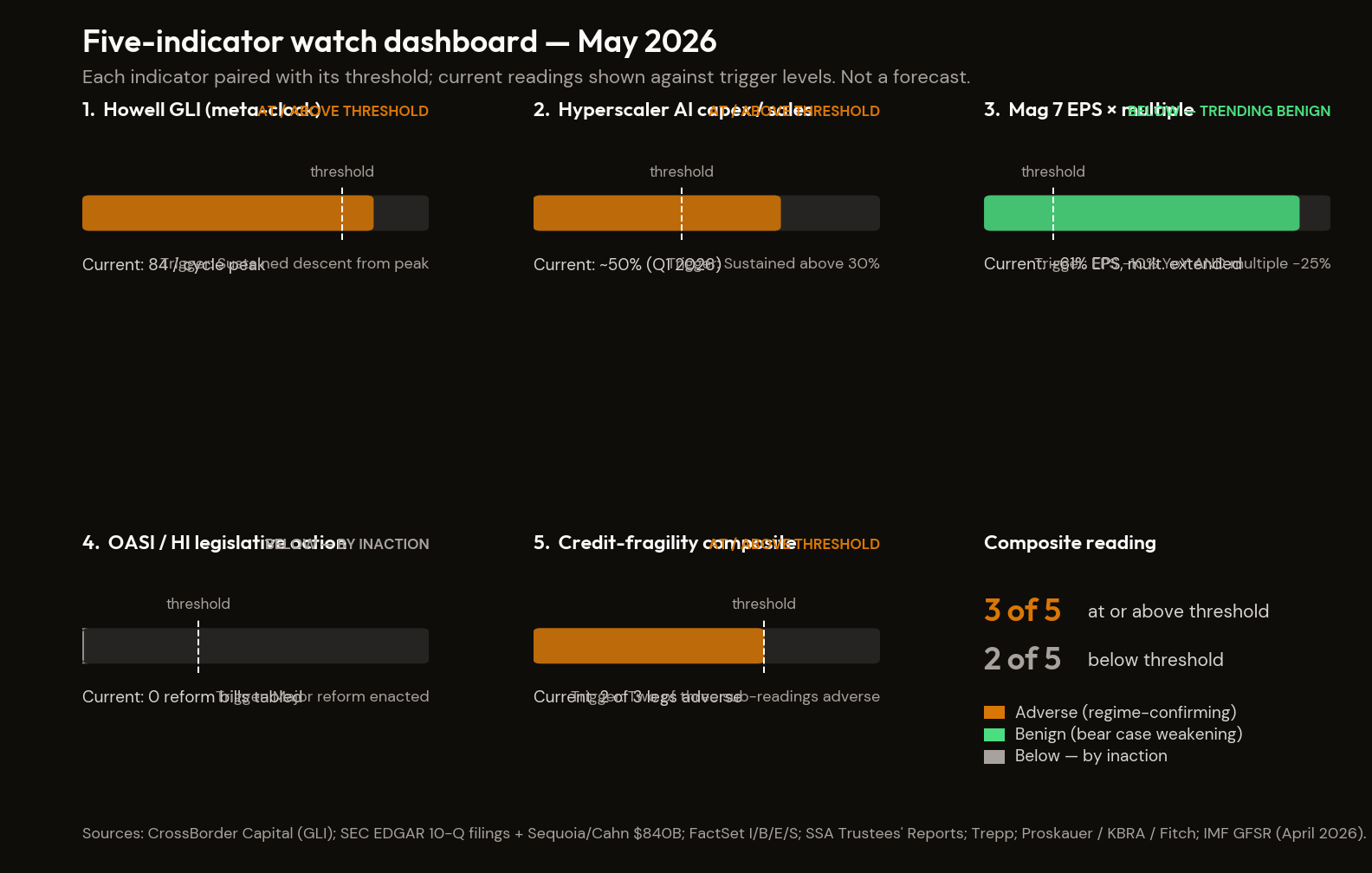
The prose walkthrough of each indicator follows. Each pairs an essay-of-origin tag, a primary-source URL, a current reading, a threshold condition, and a falsification condition. As of September 2026, none sits at threshold, one sits a leg short, and one has met its falsification condition. That is the dashboard's reporting, not an editorial choice.
Indicator 1 — Howell Global Liquidity Index (the meta-clock)
Primary source: CrossBorder Capital Global Liquidity Index, published monthly on the Capital Wars Substack.4 Essay-of-origin: Essay 12, §IV.
The index aggregates central-bank balance sheets, private-sector credit creation, and cross-border funding flows into a single composite series. It is the operational expression of Howell's 65-month cycle — the cycle whose duration approximately matches the average global debt maturity profile, which is the structural reason a cycle of that length exists at all.
Current reading (September 2026): Howell reports the index as a level in US dollars and reads a cycle position from its momentum, and as first written this indicator did not say which it meant. In May it was read off the cycle, which Howell had called at its peak ("Global liquidity has peaked and is declining", 7 April). The level moved the other way. It set a record of US$189.2 trillion in late February, fell for four weeks in March to US$187.9 trillion, passed the February record again at the end of April, and has stayed above it in every public reading since: US$193.5 trillion in early June, US$195.8 trillion in mid-September, above US$196 trillion on 22 September. Howell's own view of momentum is weaker ("momentum is lacking due to stalled underlying liquidity creation", 1 September), and the cycle series sits behind his paywall. The indicator now reads the level, because it is the series a reader can check.
Threshold condition: descent from the early-2026 peak sustained across three consecutive monthly readings confirms the Speculation-to-Turbulence transition. The March descent lasted four weeks. The threshold has not been met.
Falsification condition: if the index re-accelerates above its early-2026 peak on a sustained three-month basis, the cycle has not peaked and the watch-window timing thesis requires updating. On every reading Howell has made public, that condition has been met. The regime claim does not rest on this clock alone, but the timing of the 2026–2027 window leaned on it, and this is the clock the dashboard names as its master variable.
The meta-clock is the structural reason the other four indicators acquire their convergence weight. A descent in the Howell index without sub-reading corroboration is consistent with a one-off liquidity adjustment; the descent with multiple sub-readings approaching their thresholds in the same window is the regime signal.
Indicator 2 — Hyperscaler AI capex / sales ratio
Primary source: SEC EDGAR per-company 10-Q filings for Microsoft, Alphabet, Amazon, and Meta, aggregated against company-reported revenue.5 Essay-of-origin: Essay 4 (AI Reckoning).
The capex-to-sales ratio reads the AI capex internal clock from the source-data side rather than the revenue-gap side. The framework's question is whether the hyperscaler capex deployment is sustainable on the cash-flow base that has to fund it.
Current reading (September 2026): cash capital expenditure at Microsoft, Alphabet, Amazon and Meta ran at 30.1% of their combined sales in the first quarter of 2026 and 35.0% in the second, against a 2015–2024 norm of 12.5%.5 That is the most extended point in the series. The May version of this line put the ratio near 50%, which was never right on total sales. In dollars, second-quarter capex was $165 billion, or $660 billion annualised, and the four companies' full-year 2026 guides sum to $720–745 billion. Against that, disclosed AI revenue is roughly $109 billion, which leaves an 8× gap to the $840B that the Cahn arithmetic (Sequoia, 2025) requires at a 50% margin / 50% ROIC hurdle, and roughly 14× to his revised $1.5 trillion.6
Threshold condition: hyperscaler aggregate capex/sales ratio sustained above its 10-year historical norm by 2x for two consecutive quarters AND aggregate capex at or above $750 billion annualised. The conjunction closes the pick-one trap from the cash-flow side: capital that funded the AI build cannot find an internal funding source that justifies the sustained investment. On the filings, twice the norm is 25%. The ratio leg has been met for three consecutive quarters; the dollar leg has not.
Falsification condition: AI-attributable revenue per major hyperscaler crossing $100 billion annually on a sustained growth trajectory, indicating productivity returns are materialising at a scale sufficient to close the Cahn gap without sovereign-debt competition or balance-sheet stress. The largest disclosed figures are Microsoft's AI business above $37 billion annualised (April 2026) and AWS's AI revenue run-rate above $25 billion (July 2026). Neither is near $100 billion. October 2026: the condition needs a disclosure no hyperscaler makes as a matter of course. No filer reports AI revenue as a line; the figures above are run-rates the companies chose to state. Microsoft's fiscal fourth-quarter release reports Azure revenue above $100 billion for the first time, but Azure is the whole cloud business, and the release gives no AI figure.7 What counts is an AI revenue figure or annualised run-rate that the company itself states, in a filing, a release or on its earnings call; a cloud total or an analyst's estimate does not. Between such statements the condition is unobserved, which is not the same as unmet.
Indicator 3 — Mag 7 forward EPS revisions
Primary source: FactSet Earnings Insight (I/B/E/S consensus).8 Essay-of-origin: Essay 4 (The AI Reckoning).
The indicator is the falsification condition for Essay 4's bear case at the equity-valuation level. Essay 4 is built on a multi-channel argument — valuation, concentration, revenue-base concentration through consumer K-shape, mechanical-bid amplification. The bear case stands on the joint behaviour of earnings AND multiple, not on either alone. The indicator reads that joint behaviour as a conjunction, and the discipline is to state the conjunction in advance so the dashboard cannot be re-interpreted at signal arrival.
Current reading (September 2026): S&P 500 earnings grew 52.0% year on year in the second quarter, the fastest since 2021, and the Mag 7's grew 118.5%.8 About $151 billion of the Mag 7 figure was unrealised gains on equity stakes booked by Alphabet and Amazon, Amazon's "primarily due to investments in Anthropic"; without those two companies the group grew 43.2%. The S&P 500 forward P/E fell to 19.6, from 20.4 at the end of June. The multiple is compressing, but because earnings rose, not because prices fell, and neither conjunction describes that path. Neither is met.
Threshold condition (conjunction, bear case strengthening): BOTH (a) Mag 7 blended forward EPS revisions turning negative on a -10% YoY basis AND (b) multiple compression in excess of 25% from current extension, sustained across two consecutive quarters. Either leg alone is consistent with idiosyncratic single-channel stress; the joint movement is the regime signal. As first written, "current extension" had no number. From September 2026 the multiple is read as the S&P 500 forward P/E on FactSet, pinned at its 30 June 2026 reading of 20.4, the nearest verified reading to this essay's date, so leg (b) is a forward P/E below about 15.3. (The May reading, about 21, could not be verified; on it the line would sit near 15.8.)
Falsification condition (conjunction, bear case falsified): BOTH (a) Mag 7 EPS revisions holding or accelerating (positive YoY) AND (b) the multiple expanding rather than compressing, sustained across two consecutive quarters. Strong EPS alone does not falsify; strong EPS with multiple expansion does. Both legs have to move benign before the bear case loses this indicator — and the conjunction is stated here, in advance, so the dashboard cannot retreat to "the other axis remains intact" once one leg moves against the call.
The indicator is the one the dashboard's no-prediction discipline requires stating plainly. The earnings leg is currently moving strongly against the bear case; the multiple leg has not moved with it. The bear case on this indicator is not yet falsified — but the conjunction is stated, and the dashboard is committed to acknowledging falsification cleanly when both legs move benign together.
Indicator 4 — OASI / HI legislative action
Primary source: Social Security Administration Trustees' Reports; CBO long-term projections; legislative calendar tracking via congress.gov.9 Essay-of-origin: Essay 1 (The Math Doesn't Work).
The OASI and HI trust-fund depletion dates establish a binary trigger. Either Congress legislates a fix on the political calendar that allows ordinary legislative process to operate — multi-year hearings, bipartisan compromise, gradual phase-in — or the trust funds reach insolvency and the cuts become automatic. The political calendar is mechanical: the OASI depletion date is in the early 2030s on current Trustees' projections; the legislative-action window is therefore the 2026–2027 watch window, by simple arithmetic on the lead time required for an ordinary fix.
Current reading (September 2026): the 2026 Trustees Report puts OASI depletion in the fourth quarter of 2032, with 78% of scheduled benefits payable after it; CBO's September projections exhaust the fund in fiscal 2032, with a 26% cut.9 Both are current-law projections, and nothing enacted has pushed either date out. The threshold cannot be tested before the 2027 session ends.
Threshold condition: the 2026 mid-terms and the 2027 legislative session pass without major OASI / HI reform legislation tabled and advanced through committee. The binary tightens with each unfit window.
Falsification condition: major OASI / HI reform legislation enacted, with phased implementation beginning in 2026 or 2027, sufficient to push depletion dates outside the 2026–2030 stress window.
The indicator earns its dashboard slot because it is the cleanest available test of whether the democratic system can act on the diagnosis before the crisis forces the action. It is binary because the legislative process is binary: a fix exists, or it does not.
Indicator 5 — Credit-fragility composite
Primary sources: (a) Proskauer Private Credit Default Index; KBRA Private Credit Surveillance Compendium; Fitch Ratings private-credit default tracker.101112 (b) Trepp CMBS Delinquency Tracker (monthly).13 (c) Redemption-squeeze frequency in semi-liquid private-credit vehicles, tracked through quarterly fund disclosures and IMF GFSR reporting on the semi-liquid stock.14 Essay-of-origin: Essay 12 (Cracks).
The composite combines three signals that read the same underlying credit-fragility configuration through different channels. Reading them as a composite is the analytical move; reading any one alone is the diagnostic mistake the prior essay warned against.
Current readings (September 2026):
- Bad-PIK shadow default rate 6.2% of loans in the second quarter, up from 5.9% in the first, on Lincoln International's measure.15
- Office CMBS delinquency 12.00% in August, up from 11.57% in June and 34 basis points below January's all-time record of 12.34%.13
- Redemption requests at the largest non-traded BDCs ran at 10–15% of shares in the third quarter: Apollo Debt Solutions about 14.7%, Ares Strategic Income 13.1%, HPS Corporate Lending about 11.5%, Blackstone Private Credit about 10%. Each paid out only its 5% cap, as in the second quarter. Blue Owl Technology Income drew requests for 38.1% of its shares in the second quarter.16 The IMF's April 2026 GFSR puts approximately $300 billion in semi-liquid private-credit structures subject to retail redemption.14
Threshold condition: composite trigger — any two of (a) bad PIK shadow rate above 7%, (b) office CMBS delinquency above 15%, (c) semi-liquid private-credit gate utilisation crossing the 25% threshold on a sustained quarterly basis — confirms the credit-fragility leg of the regime claim. The conjunction is the analytical move: any one indicator alone is consistent with idiosyncratic stress; two crossing simultaneously is the structural signal. Leg (c) was never given a precise meaning, and the readings above show why that matters: requests at 10–15% of shares sit under a 25% line, while a sector in which every large fund is gated would clear any line. From September 2026 the dashboard pins it, before it could decide anything: (c) is met when redemption requests exceed 25% of shares outstanding, for a quarter, at a majority of the five funds named above (Apollo Debt Solutions, Ares Strategic Income, Blackstone Private Credit, HPS Corporate Lending and Blue Owl Credit Income). On that reading, and on legs (a) and (b), the composite is below threshold.
Falsification condition: sustained reversion across all three legs — shadow default rate below 3%, office CMBS delinquency below 8%, semi-liquid gate utilisation below 5% — confirms the credit fragility has been successfully resolved through amend-and-extend rather than crystallised through loss recognition.
The composite is the dashboard's densest signal because the three legs are connected by the insurance-mediation channel Essay 12 §V documents. Stress in any leg transmits to the others through shared collateral and shared marginal buyers. Two simultaneous threshold crossings indicate the transmission is operating, not that two independent stress events have arrived.
III. Cross-Indicator Convergence
A single indicator crossing its threshold is a data point. Two indicators crossing simultaneously are a regime signal — the same underlying condition expressing itself through independent channels. The significance is not additive; it is the co-movement signal Essay 12 identifies as the structural precursor to phase transitions.
Time-structure matters. Sequential threshold crossings — one indicator crossing, then another months later, then a third — provide less regime confirmation than simultaneous crossings, because sequential crossings are individually consistent with idiosyncratic stress in each indicator's source mechanism. The analytical question the dashboard asks in real time is not just has any indicator crossed but are the crossings clustering in time.
Three specific convergence cases are worth developing in detail.
Convergence A — meta-clock plus credit-fragility composite. Indicator 1 (Howell index in sustained post-peak descent) AND Indicator 5 (credit-fragility composite at any two of three legs). Joint signal: the master liquidity vector is contracting at exactly the moment the credit-fragility legs that couple most tightly to it (private credit through the insurance-mediation channel, CRE through the regional-bank channel, semi-liquid private credit through retail-redemption gates) are losing their amend-and-extend optionality. This is the cleanest co-movement reading the dashboard can produce because the coupling is structural rather than coincident: collateral-cascade procyclicality in the credit complex is the mechanism by which the liquidity contraction transmits to recognised loss. As of September 2026, neither half is present. The Howell index is rising rather than descending, and neither numbered leg of the credit-fragility composite is above its line. The configuration is further from convergence than it was in May.
Convergence B — capex/sales plus EPS × multiple conjunction (the pick-one trap closing). Indicator 2 (hyperscaler capex/sales sustained at 2x its 10-year norm AND aggregate capex at or above $750B annualised) AND Indicator 3 on the bear-conjunction side (Mag 7 EPS revisions turning negative on the -10% YoY threshold AND multiple compression in excess of 25%, both sustained across two consecutive quarters). Joint signal: AI capex at the most extended point in its modern series, with the funding base for that capex contracting at the earnings level AND the multiple compressing — the pick-one trap from The AI Reckoning closing from both sides simultaneously. As of September 2026, Indicator 2's ratio leg is past its line, at the most extended point in the series, and Indicator 3's earnings leg is moving strongly in the opposite direction from the bear conjunction. The configuration is far from convergence on this pair.
Convergence C — meta-clock plus OASI / HI legislative inaction. Indicator 1 (Howell index in sustained descent) AND Indicator 4 (no major OASI / HI reform legislation tabled through 2027). Joint signal: the structural fiscal-arithmetic constraint is binding at exactly the moment the liquidity vector contracts. The Fed cannot fix what Congress will not legislate; the legislative window has a calendar; the meta-clock has a calendar; the two calendars overlap in the watch window. Indicator 4 cannot be scored until the 2027 session ends; nothing has been enacted, and the binary tightens by default as the window narrows. Its partner in this pair is moving the other way: the Howell index has not descended.
The convergence cases establish what to watch for when the dashboard activates. The harder discipline is the inverse: what would have to be true for the entire watch-window thesis to be wrong? That is the next section's question.
IV. What Would Falsify the Watch Window Thesis Entirely
Each indicator in §II carries its own falsification condition — the reading that would falsify that specific indicator's analytical claim. The question here is different: what would falsify the watch-window thesis entirely, not indicator-by-indicator but at the regime level?
The primary falsification scenario is structural, not incremental: the Fed pivots and it works. Specifically, the Fed cuts rates in 2026–2027 and the velocity-collapse condition the Hunt framework names reverses on a sustained basis — money begins to circulate at a rate consistent with monetary transmission to the real economy operating again. October 2026, written before the 28 October FOMC statement: a cut that only unwinds the 16 September hike, made during an oil shock, does not by itself meet this condition; it is met when M2 velocity, which read 1.418 in the second quarter of 2026, holds above 1.435, its last pre-pandemic reading (fourth quarter of 2019), for two consecutive quarters after a cut.17 That would mean the watch-window's central architectural premise — that the backstop is asymmetric precisely when it is most needed — is incorrect. Not adjustment. Revision. The Hunt-Howell combination Essay 12 §X names describes a system in which the liquidity cycle peaks at exactly the moment the traditional emergency response has lost its growth-generating effectiveness. If Hunt is wrong on the asymmetry, the entire timing thesis requires updating.
A secondary falsification scenario operates on a different mechanism: hyperscaler AI-attributable revenue per major company crosses $100 billion annually on a sustained growth trajectory. If AI productivity returns materialise at a scale sufficient to justify the capex without sovereign-debt competition, the forced-choice clock stops ticking on the AI side. The latest disclosed readings place Microsoft's AI business above $37B annualised (April 2026) and AWS's AI revenue run-rate above $25B (July 2026). The threshold for this falsification is approximately three times those levels for the leading hyperscaler, with sustained quarter-over-quarter growth in a band consistent with the capex-revenue ratio approaching parity. What counts as a reading is set out under Indicator 2.
A third secondary falsification scenario operates on the cross-essay motif the diagnostic block has traced — the mechanical-bid reversal that the demographic curve underneath the asset-price regime imposes. The condition is structural: fertility rates in major economies rebound above replacement on a sustained basis (2+ years of data) OR mass-immigration policy produces net-positive labour-force growth sufficient to offset the Boomers' RMD decumulation curve. If demographic headwinds reverse on either mechanism, the mechanical-bid reversal The End of the Bull Run and The Demographic Crunch document is partially mitigated. This is not a 2026–2027 watch-window condition; demographic reversal operates on a multi-year horizon. It belongs in the falsification framework because the regime claim is conditional on the demographic curve being intact, not because the dashboard can confirm or deny it inside the window itself.
These are the conditions that would require revision of the regime claim — not of one indicator, but of the posture the entire manuscript's diagnostic block has built. The final question is not what would falsify it, but what to do with conflicting signals in real time, before the primary or secondary falsification conditions are fully met or fully refuted.
V. Reading the Clocks Honestly
The dashboard does not tell you what you want to hear. It tells you what the hands are showing. Hold the composite signal, not the most convenient individual signal. Read all five indicators as a system. Maintain the regime claim while the structural conditions that generated it remain intact; revise it when those structural conditions are themselves disconfirmed at the dashboard level, not when one indicator tells an inconvenient story while the others confirm the architecture.
The clocks read what they read. The next question is what to do with the reading — not prediction, but posture. The Survival Framework takes it from here.
Footnotes
-
Yaneer Bar-Yam and the New England Complex Systems Institute working-paper record on cross-equity co-movement as a criticality signature, available via the NECSI publications portal. Bar-Yam published working papers on this co-movement metric in 2007 and 2008 (NECSI). Bar-Yam, Making Things Work: Solving Complex Problems in a Complex World (NECSI Press / Knowledge Press, 2004) develops the conceptual frame. ↩
-
Philip E. Tetlock and Dan Gardner, Superforecasting: The Art and Science of Prediction (Crown Publishers, 2015). ISBN 9780804136716. Penguin Random House. ↩
-
Nassim Nicholas Taleb, "Antifragility, Robustness, and Fragility Inside the 'Black Swan' Problem," working paper: arxiv.org/abs/1108.1119. The h″(x) < 0 fragility formulation is elaborated mathematically in the paper and in the Technical Appendix of Antifragile: Things That Gain from Disorder (Random House, 2012). ↩
-
CrossBorder Capital — Global Liquidity Index, Capital Wars Substack (monthly). ↩
-
SEC EDGAR — per-company 10-Q filings: MSFT, GOOG/GOOGL, AMZN, META. The September 2026 ratio is computed from the filings' XBRL data (SEC company facts API): quarterly cash purchases of property and equipment summed across the four, divided by their summed total revenue. Finance leases are excluded. The norm is the 2015–2024 aggregate (39 quarters; one Amazon quarter is not separable in the data). ↩ ↩2
-
Microsoft — FY26 Q4 earnings press release, 29 July 2026: "This year, Azure revenue surpassed $100 billion for the first time". The release reports Azure growth and no AI revenue figure. ↩
-
FactSet — S&P 500 Earnings Season Update (May 1 2026); September 2026 reading from FactSet, Earnings Insight, 28 August 2026. ↩ ↩2
-
Social Security Administration — Trustees' Reports; 2026 Trustees Report summary; CBO, 2026 Long-Term Projections for Social Security, 17 September 2026. ↩ ↩2
-
Proskauer Private Credit Default Index — Q1 2026 rate at 2.73%. ↩
-
KBRA — Private Credit Q3 2025 Middle Market Borrower Surveillance Compendium. ↩
-
Fitch Ratings — US Private Credit Default Rate Continues Upward March to 5.8% in January 2026 (February 2026). ↩
-
Trepp — CMBS delinquency report, August 2026 (1 September 2026). Trepp publishes the report monthly on TreppTalk; the tracker page this note first linked no longer resolves. ↩ ↩2
-
Lincoln International — The Lincoln Private Market Index, Q2 2026 (13 August 2026). ↩
-
Tender-offer filings on SEC EDGAR: Apollo Debt Solutions BDC, 8-K, 22 September 2026; Ares Strategic Income Fund, SC TO-I/A, 24 September 2026; Blue Owl Technology Income Corp, SC TO-I/A, July 2026. ↩
-
FRED — Velocity of M2 Money Stock (M2V), quarterly, read 19 October 2026: 2.192 in 1997 Q3, the series high; 1.435 in 2019 Q4; 1.126 in 2020 Q2; 1.163 in 2022 Q1; 1.418 in 2026 Q2. The baseline is the last quarter before the pandemic because the rise since 2020 recovers the pandemic collapse and does not, by itself, reverse the decline from 1997. Scored from the 2022 low, that recovery would already count as the reversal. The oil shock: FRED — Brent crude spot (DCOILBRENTEU), monthly averages of daily prices, $66.60 in January 2026 and $114.16 in September. The hike: FOMC statement, 16 September 2026. ↩